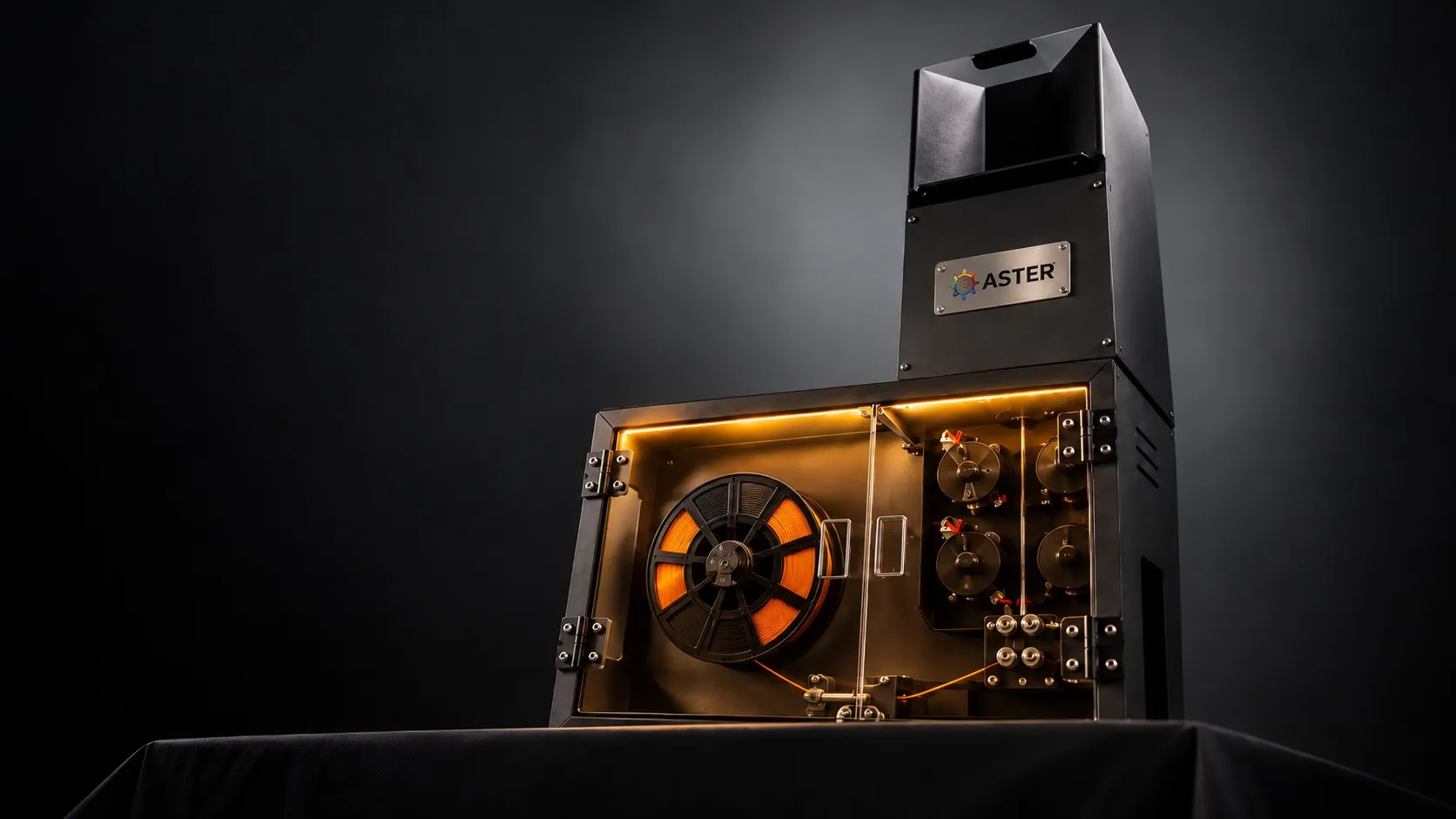
Produce Your Own
3D Printing Filament
Work with polymers, additives and formulations your application requires, and turn them into ready-to-use filament without depending on external suppliers.
Used by early adopters at
 CSIR – National
Chemical Laboratory Indian Institute of
Technology Delhi Birla Institute of Technology
and Science, Pilani MIT World Peace
University, Pune
More Control Over the Materials You 3D Print With
Develop Your Own Materials
Blend polymers, fillers, reinforcements and additives into filament built for your research.
Produce What You Need
Small batches in your material and diameter, with no supplier minimum orders.
Reprocess & Reuse
Turn suitable scrap, failed prints and leftover material back into usable filament.
How ASTER-C Works
- 01
Load
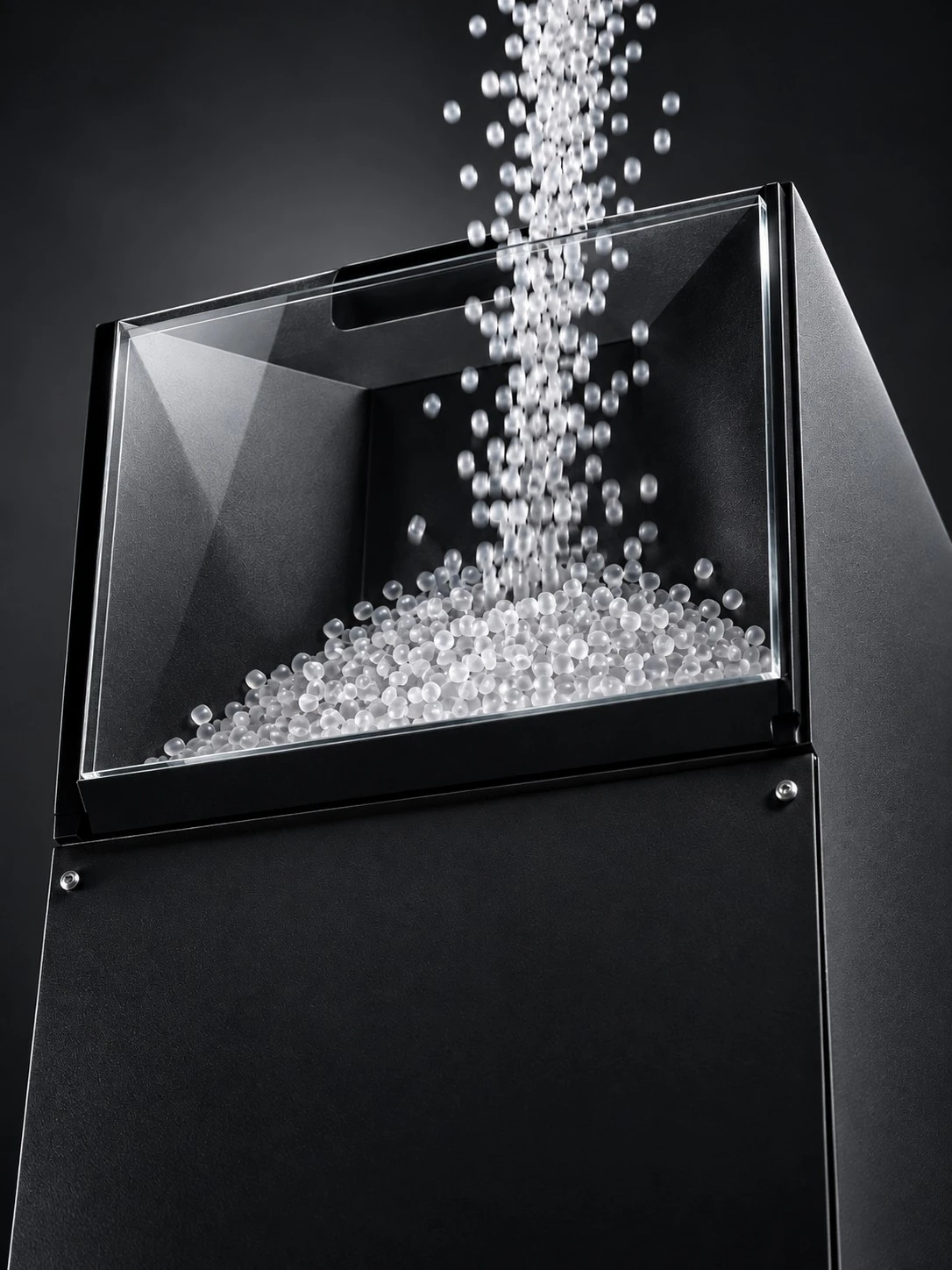
Feed polymer pellets, granules or recycled material into the hopper. Add fillers, reinforcements or colourants as required for your formulation.
- 02
Extrude
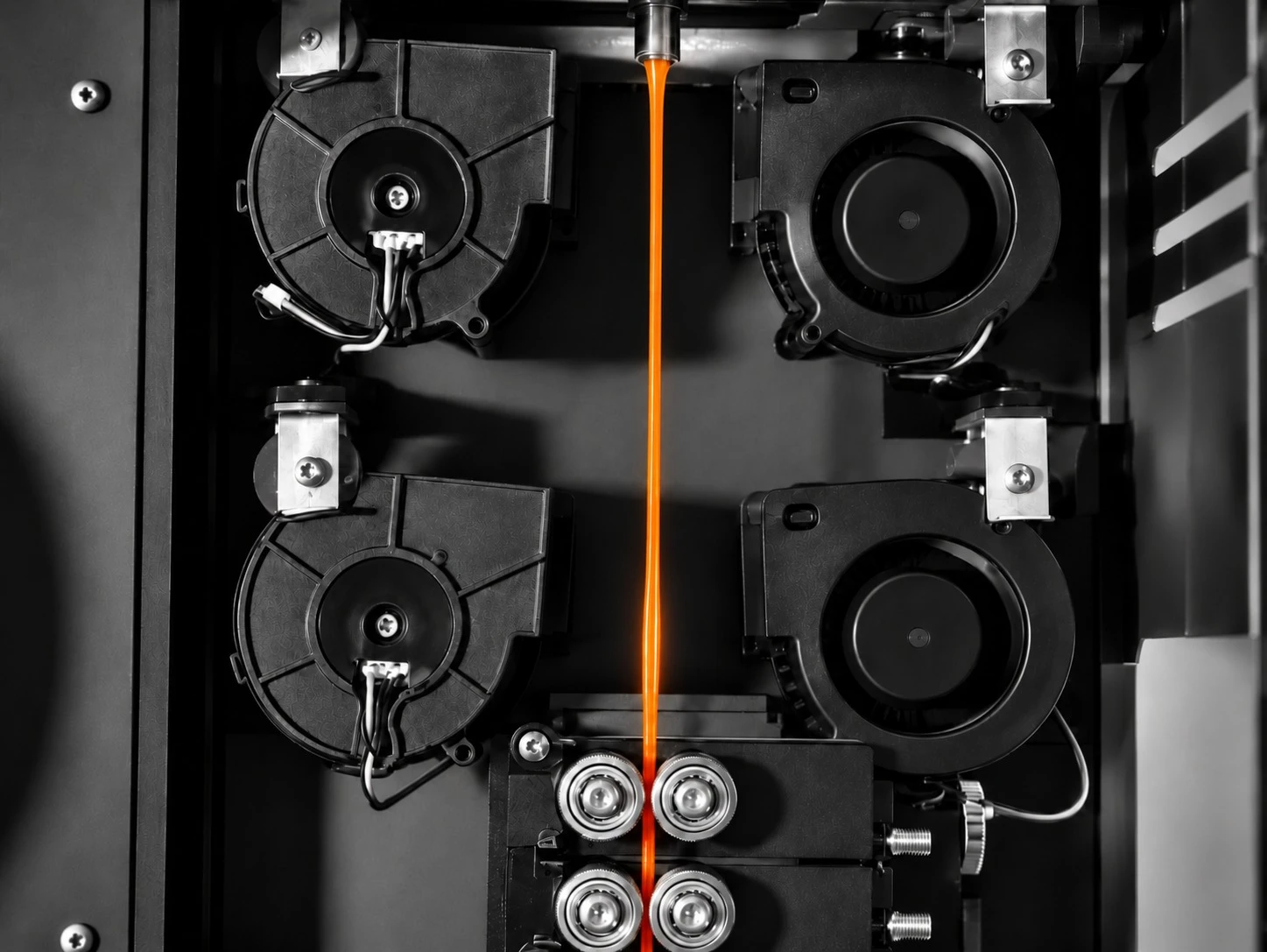
Set the processing temperature and screw speed through the PC interface. A single screw with mixing zones and four heating zones melt, mix and extrude the material at up to 450°C.
- 03
Diameter Control
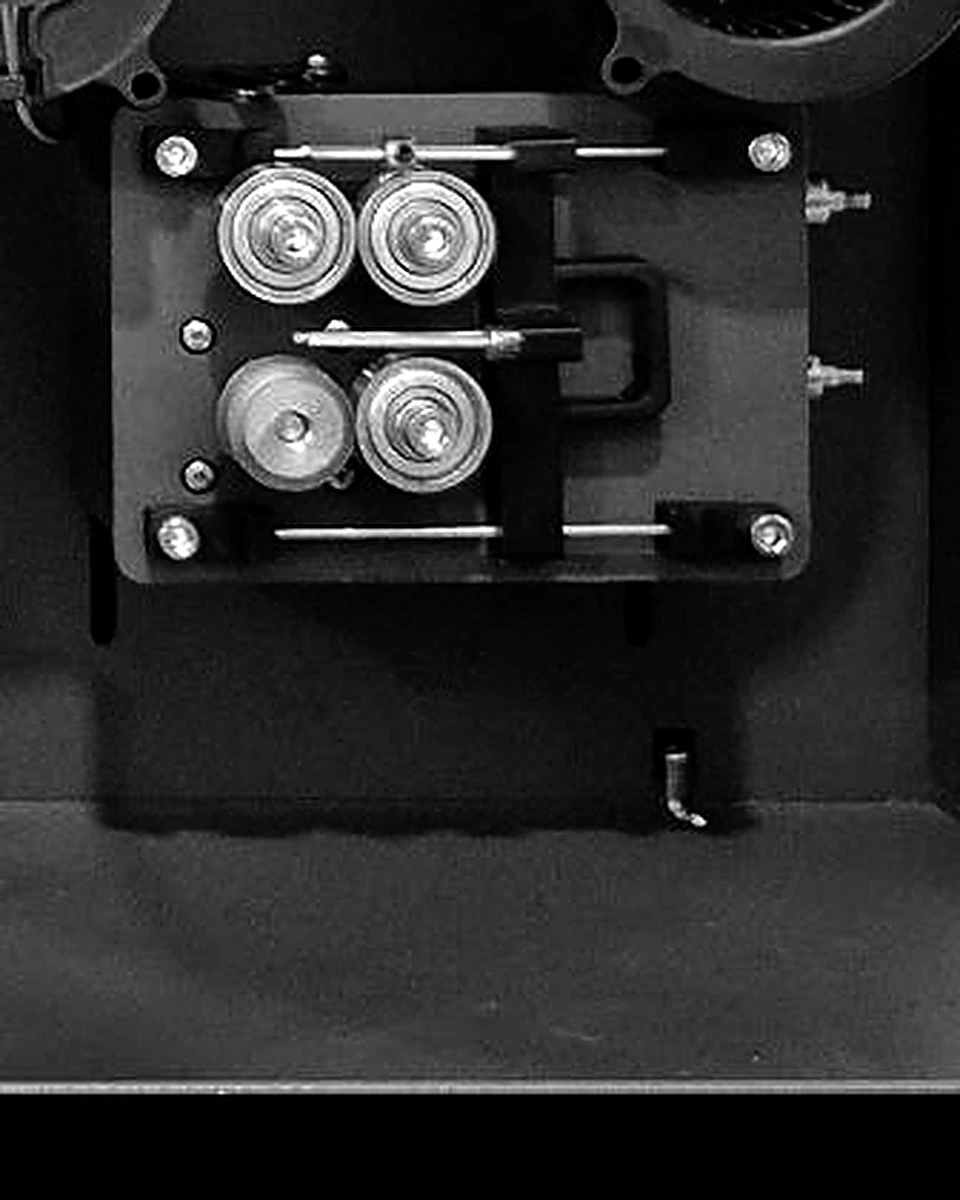
Continuous, automatic diameter control through a mechanical diameter sensor and puller. Virgin polymers extrude to a tolerance of ±0.05 mm and recycled polymers to ±0.1 mm.*
*Tolerance depends on material grade and parameter settings. - 04
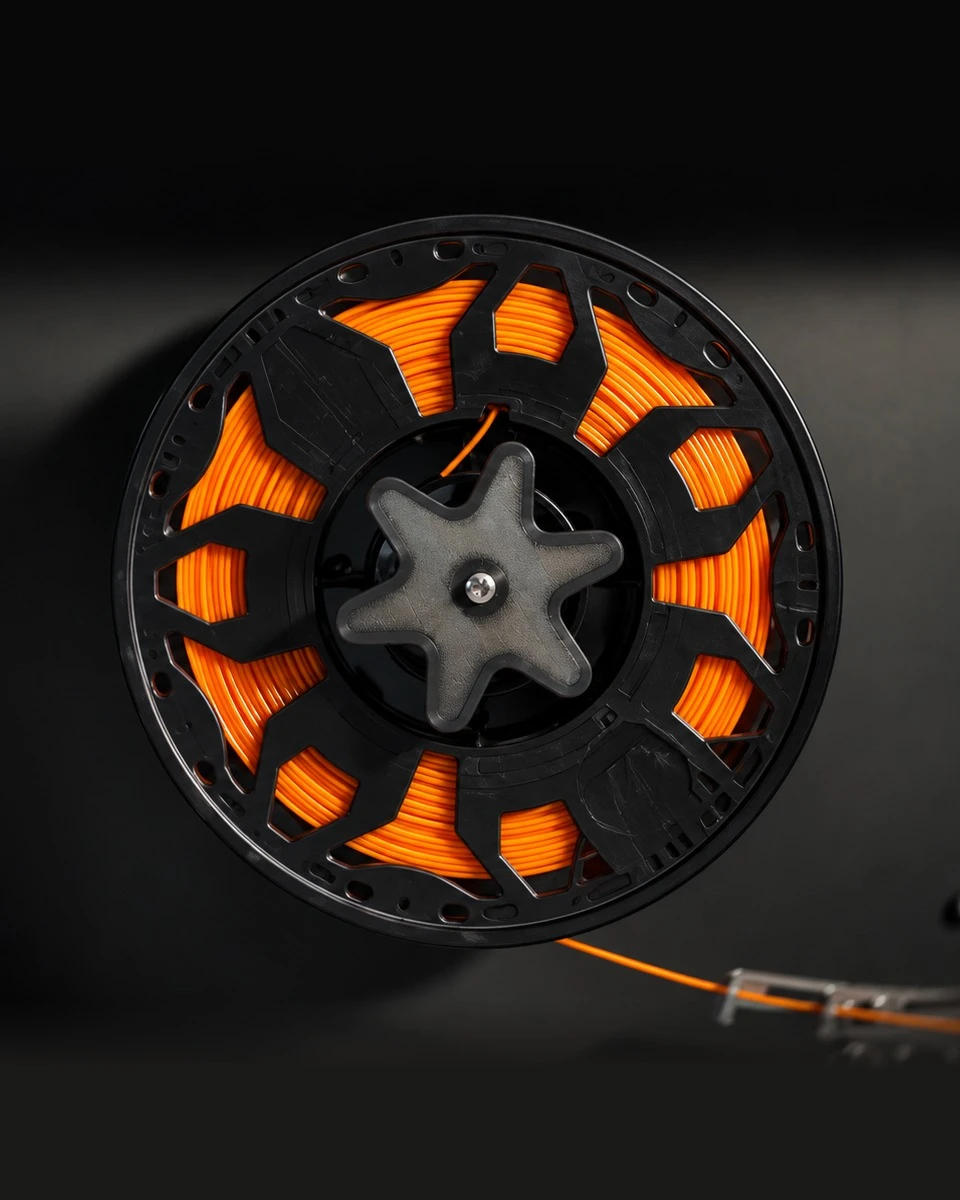
Spool
The extruded filament passes through adjustable air cooling before being wound onto a spool.
Compatible Polymers,
Fillers & Additives
Explore the thermoplastics and compatible additives that can be processed with ASTER-C to develop standard, reinforced and specialised 3D printing filaments.
- PLA / PETG / ABSStandard 3D printing polymers, including suitable recycled and modified formulations.
- Polycarbonate (PC)Polycarbonate and compatible PC blends for applications requiring strength and heat resistance.
- Nylon (PA6 / PA12)Polyamide grades, including compatible glass fibre and carbon fibre reinforced blends.
- PEEK / PEKK / PEI (ULTEM-Class)High-temperature engineering thermoplastics with high thermal stability and mechanical performance, used in advanced engineering and material research.
- Custom CompositesThermoplastic formulations incorporating compatible reinforcements, functional fillers, pigments and additives.
- Carbon FibreStrength & stiffness
- Glass FibreStructural reinforcement
- Metal PowdersFunctional composites
- Natural FibresBio-based composites
- AdditivesProcessing & stability
- PigmentsColour modification
- SurfactantsFiller dispersion
- Mineral FillersProperty modification
- ThermosetsCure irreversibly and will not re-melt, so they pack cured material into the barrel.
- PVCReleases corrosive decomposition products at extrusion temperature that attack the screw and barrel.
Processing thermosets or PVC is not covered by the warranty.
Built for the Work You Do
University & Research Laboratories
Develop new polymer formulations, evaluate material properties and produce experimental filament batches for research and testing.
3D Printing Services & Print Farms
Produce custom filament grades and diameters, reprocess suitable print waste and meet specialised material requirements.
Filament Manufacturers & Startups
Develop and validate new filament formulations, optimise processing parameters and produce small batches before scaling up production.
Composites & Industrial R&D
Investigate reinforced thermoplastics, experiment with filler concentrations and develop functional composite filaments for engineering applications.
ASTER-C Technical Specifications
Thermal450°C
- Temperature range
- Room temperature to 450°C
- Heaters
- 3 ceramic band heaters
- Heating zones
- 4: feeding, compression, metering, mixing
Screw & drive340 mm
- Screw type
- Single screw with engineered mixing zone, for recycled polymers and composites
- Screw length
- 340 mm
- Screw diameter (max)
- 25 mm
- Screw speed
- 0–100 RPM
- Drive
- Stepper motor with encoder
- Screw / barrel
- EN41B, screw nitrided and chrome plated; barrel case hardened
Filament±50 µm
- Diameter range
- 0.5–3 mm, user definable
- Diameter sensing
- Mechanical sensor, ±50 µm accuracy
- Puller & spooler speed
- Automatic, with manual override
- Cooling
- Air cooled
- Extrusion direction
- Vertical
MaterialsOpen system
- Compatible
- All extrusion-grade, non-corrosive thermoplastics
- Fillers
- Carbon / glass fibre, metal powders, natural fibres, additives, colourants, surfactants
- Not compatible
- Thermosets and PVC
Capacity & size35 kg
- Hopper
- > 2.5 L
- Spool
- 0–3 kg spools, magnetic spool holder
- Dimensions
- 250 × 590 × 910 mm
- Weight
- 35 kg, tabletop
Power & control230 V
- Power
- Single phase, 230 V 50 Hz AC
- Peak consumption
- ~1500 W
- Interface
- Windows PC GUI (PC not included)
- Data logging
- Continuous diameter sensor data logging, historic data trends and complete parameter control in the GUI
Try Before You Buy
Get filament made from your own material and print with it before you commit to ASTER-C.
Share Your Requirements
Tell us the polymers, fillers or additives you want to run and the filament diameter you need. We confirm whether ASTER-C can process them.
Compatibility checkTest Your Material
Send us your feedstock for an extrusion trial. You get a filament sample to measure, test and print with on your own printer.
Filament sampleProduce In-House
Happy with the sample? Order ASTER-C for your facility, set your parameters and make filament whenever your work needs it.
Your own production
Frequently Asked
Questions (FAQs)
Which materials can ASTER-C extrude?
All extrusion-grade, non-corrosive thermoplastics. On top of the base polymer you can run filler materials: carbon fibre, glass fibre, metal powders, natural fibres, chemical additives, colourants and surfactants.
The screw's specially engineered mixing zone is what makes this work — it is the reason ASTER-C handles composite blends and recycled polymer rather than only virgin single-grade feedstock.
What can it not run?
Strictly no thermosets, and strictly no PVC.
Thermosets cure irreversibly and will not re-melt, so they cannot be extruded — attempting it packs cured material into the barrel. PVC releases corrosive decomposition products at extrusion temperature that attack the screw and barrel. Neither is covered by the warranty.
How is filament diameter controlled?
Diameter is user-definable anywhere between 0.5 mm and 3 mm, which covers the common 1.75 mm and 2.85 mm printing standards and everything between.
Measurement is mechanical: a Hall-effect sensor reads the gap between two rollers that physically contact the filament, giving accuracy within 50 microns. A second set of rollers below it, driven by a stepper motor, pulls the strand — puller and spooler speed tune automatically, with manual override available.
How is the screw built?
A single screw, 340 mm long and up to 25 mm in diameter, in EN41B steel that is nitrided and chrome plated. The barrel is EN41B case hardened. It turns at 0 to 100 RPM on a stepper motor drive with encoder.
How is the machine controlled, and is a PC included?
Through a GUI running on a Windows PC. The PC is not quoted as standard with the machine and must be arranged by the user.
The GUI sets the temperature of each zone, screw RPM, and the PWM intensity of the cooling and hopper fans. A logging toggle records extrusion data to a CSV file you can open after the run. Further firmware updates to improve data access are planned.
What does it need to run?
A single-phase 230 V 50 Hz supply, drawing around 1500 W at peak, and roughly 250 × 590 × 910 mm of bench space. The machine weighs 35 kg.
The hopper holds more than 2.5 litres of feedstock, and the magnetic spool holder takes 0–3 kg spools. Filament is extruded vertically and air-cooled on the way down.
Get in Touch
Questions about ASTER-C, pricing or a material trial? Send us a message and we’ll reply within one working day.
sales@printgloo.com